
EPR and eco-modulation: what they cost your brand and how we reduce the costs.
Extended Producer Responsibility is becoming mandatory for textiles across the EU. The fee you pay per garment isn't fixed — it moves with how your product is made. Here's how the system works, and how brands are using fibre-to-fibre recyclable materials to cut their compliance bill.
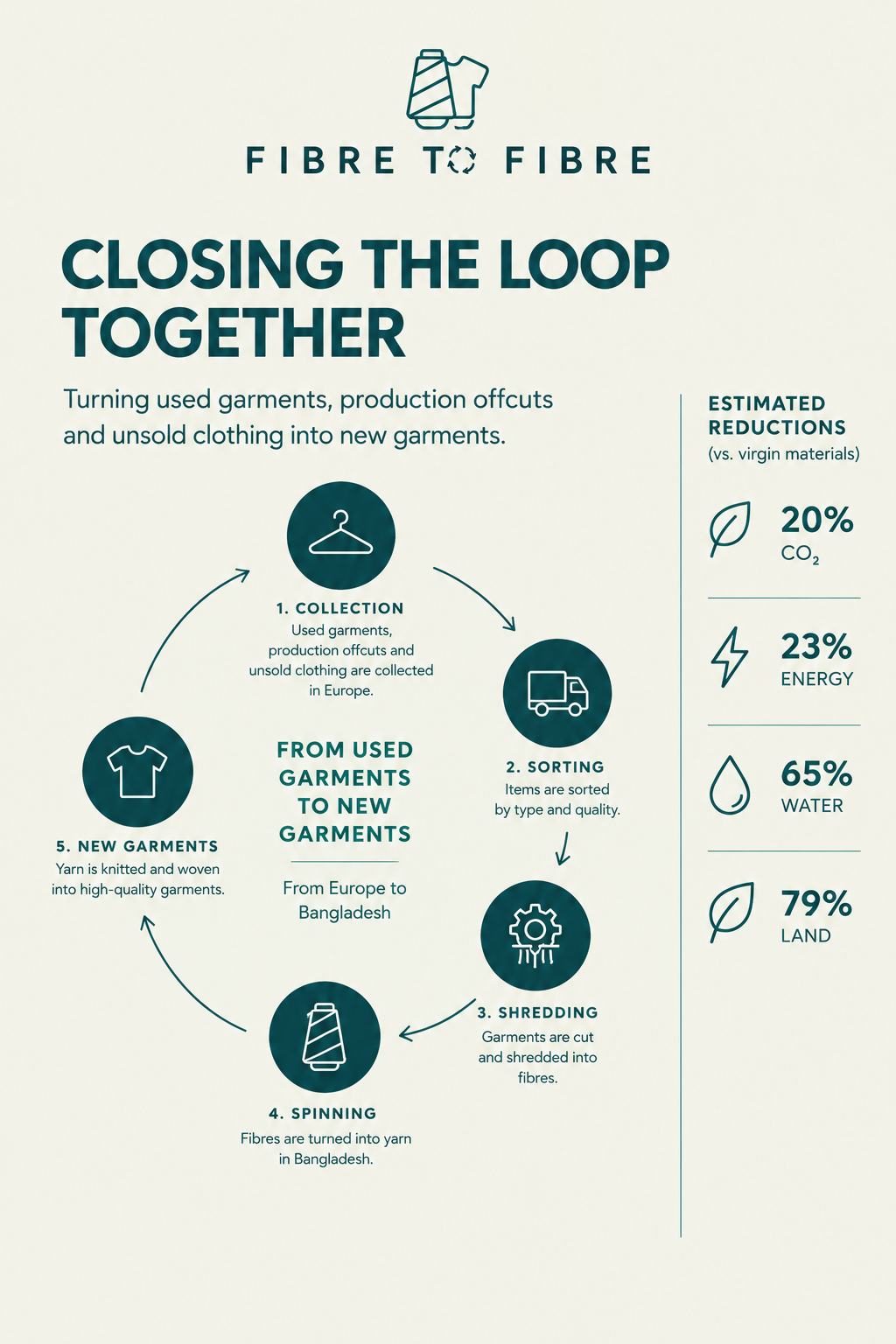

The Global Fashion CFO Agenda report indicates that textile EPR schemes could erode net profit by around 4% by 2030 for a large mass-fashion player, driven by a potential 1.1% increase in cost of goods sold.
2007
France Launches the first textile EPR system in the EU
2028
Target year for mandatory EPR in every EU member state
Up to 50%
Fee reduction available through eco-modulation bonuses.
What EPR requires from a clothing brand:
Extended Producer Responsibility shifts the cost of what happens to a garment after it's sold.
Collection, sorting, reuse, recycling, disposal are put onto the business that took it to market.
France has run a dedicated textile EPR scheme since 2007, administered by the eco-organisation Refashion, and it's the most mature model in Europe.
The Netherlands followed with its own scheme in 2023, and Italy has a decree in draft.
Under the EU's revised Waste Framework Directive, every member state is expected to have a mandatory scheme operating by 2028. This means a brand selling across the EU will face this fee structure in every market it touches.
Obligations:
Registration. You register in a national producer registry, or with an approved Producer Responsibility Organisation (PRO), in every EU country where you place products on the market.
Fee payment. You pay a per-unit eco-fee, calculated from the volume you sell and the characteristics of each product.
Reporting. You report sales volumes and, increasingly, product-level data: material composition, recycled content, certifications. These impact how your fee is calculated.
How eco-modulation turns product design into a fee:
Eco-modulation adjusts the standard EPR fee up or down based on how a specific product is designed, rather than charging every producer the same rate.
Under France's Refashion model (the clearest working example in Europe) the adjustment runs through a small number of levers.
Bonuses can often be combined on the same product, and they're calculated per item or per tonne depending on the category. As other EU countries stand up their own schemes over the next two years, they're expected to follow the same basic logic: reward what's recyclable and durable, charge more for what isn't.
-
1) Recycled content bonus: up to €1,000 per tonne for using recycled raw material from post-consumer textile waste.
2) Durability bonus: awarded for products that meet defined physical durability criteria — the garment has to last, not just look sustainable.
3) Environmental certification bonus: €0.03–€0.30 per item for finished products certified by a recognised label such as GOTS or the EU Ecolabel.
-
Recyclability penalty: products that are genuinely difficult to sort or recycle e.g. mixed fibres, nonremovable trims, hard-to-separate components, attract a higher fee, not a lower one.
Why Fibre to Fibre is the highest leverage fix:
Of all the design choices that feed into eco-modulation, fibre-to-fibre recyclability touches the most levers at once. A garment built for fibre-to-fibre recycling — genuinely mono-material, or cleanly separable into single fibre streams, with trims and hardware that don't contaminate the recycling process — sits on the right side of every criterion above: it avoids the recyclability penalty outright, and it's the design precondition for eventually incorporating recycled content, which is where the largest bonus sits.
A polyester-cotton blend garment with bonded trims is the textbook case a recyclability penalty is designed for: sorters can't easily separate the fibres, so it's more likely to end up incinerated or landfilled than recycled, and the fee reflects that cost. The same garment redesigned as mono-material polyester, with removable trims, moves from "penalised" to "bonus-eligible" without changing anything else about how it looks or performs.
Illustrative comparison based on the criteria published in France's Refashion eco-modulation model. Exact fee amounts depend on category, weight, and the specific bonuses claimed — model your own SKUs against the current published fee schedule before committing to a number
-
Base eco-fee: Standard rate
Recyclability: Penalty applied
Recycled content: Not eligible
Certification: Not certified
Net fee per unit = Highest
-
Base eco-fee: Standard rate
Recyclability: No penalty
Recycled content: Bonus-eligible
Certification: Bonus-eligible
How to prepare - 5 Steps:

Step 1
Get garment composition data to SKU level.
Eco-modulation runs on product-level data. If your design and sourcing teams don't already track fibre composition, trims, and recycled content per style, that's the first gap to close.
Step 2
Quick audit current range against bonus/penalty criteria
Flag which existing styles would attract a recyclability penalty today, and which are close to qualifying for a certification or recycled-content bonus with a small change
Step 3
Build textile to textile recycling into product development
Using recycled materials is a pricing and bottom line decision under EPR.
Step 4
Develop circular garments in collaboration with Fibre to Fibre
Reach out to Fibre to Fibre to discuss producing circular garments here
Step 5
Model fee exposure before the next collection is shipped
Run your actual SKU mix against the published fee schedule so eco-modulation is a cost input in range planning, not a surprise on next year's invoice.
FAQs: Fibre to Fibre and EPR
What is EPR for clothing brands?
Extended Producer Responsibility (EPR) is a regulatory framework that makes the brand or importer placing a garment on the market financially responsible for what happens to it at end of life — collection, sorting, reuse, and recycling. In practice, it means registering with a national scheme, paying a per-unit fee, and reporting sales and product data
How does Fibre to Fibre reduce eco-modulation fees?
A garment designed for fibre-to-fibre recycling — genuinely mono-material or cleanly separable, without contaminating trims — avoids the recyclability penalty and is better positioned to qualify for recycled-content and certification bonuses.
Is EPR mandatory across the EU?
Not yet everywhere. France has run a mandatory scheme since 2007 and the Netherlands since 2023. Under the EU's revised Waste Framework Directive, every member state is expected to have a mandatory, eco-modulated textile EPR scheme operating by 2028, so most other countries are currently in the process of building theirs.
Which EU countries already have EPR schemes for textiles?
France (since 2007) and the Netherlands (since 2023) have live, mandatory schemes. Italy has a decree in draft. Most remaining EU member states are expected to launch schemes between 2026 and 2028 under the EU-wide mandate.
What is an eco-modulation fee?
Eco-modulation adjusts the standard EPR fee up or down based on how sustainably a specific product is designed. In France's model, this takes the form of bonuses for recycled content, environmental certification, and durability, and a penalty for products that are difficult to recycle.
Who has to pay textile EPR fees?
The producer — generally the brand owner or the importer bringing garments into a given EU country — is responsible for registering and paying the fee, regardless of where the garment was manufactured.